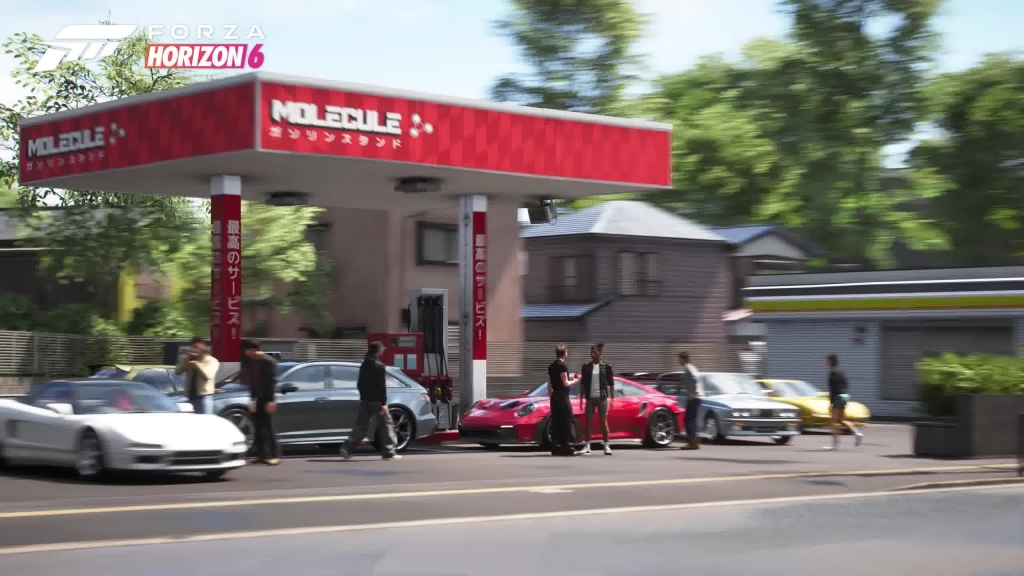
In Forza Horizon 6, the first Car Pass release immediately sets the tone for how Playground-style content cadence is shaping up in this entry. The spotlight car is the Nissan Skyline GT-R R32 Group A race machine—often associated with the iconic “Calsonic” livery culture, even if this version arrives without the official branding on its bodywork.
Despite the missing badge, the identity is unmistakable: stripped interior, side-exit exhaust, full roll cage, center-lock wheels, and a touring car silhouette built for high-speed circuit aggression rather than street aesthetics.
Car Pass Spotlight: Nissan Skyline R32 Group A (Unbadged “Calsonic-style” build)
This early Car Pass drop functions as both a collector piece and a tuning sandbox. It sits in that sweet spot between nostalgia and performance utility.
Core Specifications
| Attribute | Value |
| Engine | 2.6L RB inline-6 (RB26 variant family) |
| Drivetrain | AWD |
| Power | 641 HP |
| Torque | 667 Nm |
| Weight | 1,261 kg |
| Vehicle Class | Group A / JTC-inspired build |
| Layout | Mid-90s Japanese touring car spec |
| Induction | Turbocharged |
This configuration places it firmly in a balanced AWD sprint category—strong traction, stable corner exit, and predictable mid-corner rotation.
Driving Character: Stock Behavior Analysis
Out of the box, the car behaves like a modernized Group A racer tuned for accessibility rather than simulation rigidity.
Stock Handling Profile
- Corner entry: stable with mild understeer at high speed
- Mid-corner: neutral balance with AWD correction
- Exit traction: strong, minimal wheelspin
- Braking: highly responsive for its weight class
- Stability: very forgiving at limit
The most important trait is consistency. It does not punish minor mistakes heavily, which makes it ideal for Rivals runs and learning circuits.
Performance Benchmark (Stock vs Tuned)
A first Rivals sprint run placed the car at roughly 235th-ish range performance equivalent on a new circuit, which is a solid baseline considering unfamiliar track conditions.
| Metric | Stock Setup |
| Top speed | ~200+ mph potential |
| Corner grip | High stability, mild push |
| Acceleration feel | Linear AWD delivery |
| Lap consistency | High |
| Driver confidence | Moderate-high |
The initial run is not about raw competitiveness—it’s about establishing a tuning baseline.
The First Tune Experiment: From Balanced AWD to Aggressive Rotation Setup
The key direction was not maximum power conversion, but sharpening response without destroying drivability.
Adjustments Made
| System | Change |
| Aero | Slight adjustment for stability balance |
| Differential | Increased rotation tendency |
| Suspension | Minor responsiveness tweak |
| Power limiter | Adjusted restrictive parameters toward ~900 output ceiling behavior |
| Gear ratios | Mostly unchanged |
| Tire setup | Evaluated stock vs wide slick tradeoff |
The goal: reduce understeer while introducing controlled oversteer rotation.
Tire & Grip Tradeoff Analysis
One of the most important discoveries in this build is that stock slicks outperform aftermarket slicks in certain configurations.
Lateral Grip Comparison
| Tire Setup | Lateral G (Front/Rear) |
| Stock slicks | 124 / 140 |
| Wide aftermarket slicks | 158 / 170 |
At first glance, wider tires appear superior—but weight gain (~+16 kg) and altered geometry reduce overall agility and responsiveness in tighter sprint sections.
Conclusion:
For this chassis, stock slicks preserve balance better than wide drag-style configurations.
Power vs Control: The Real Tuning Dilemma
Increasing grip and power simultaneously created an unexpected result: the car began behaving like a hybrid drag-sprint build rather than a circuit-focused Group A machine.
This led to three viable build directions:
Build Paths
| Build Type | Characteristics | Risk |
| Balanced AWD (current) | Stable, predictable | Low ceiling |
| High-grip wide tire build | Faster straight-line stability | Heavy, sluggish rotation |
| Aggressive rotation tune | Faster cornering, tail-happy | Higher skill requirement |
The chosen direction favors the third option with controlled oversteer.
Driving Feel After Tune Changes
Post-tune behavior changed significantly:
- Understeer is almost fully eliminated
- Rear rotation becomes predictable under throttle
- Corner entry speed increased
- Mid-corner correction required less braking
- Exit traction remains strong due to AWD system
Key Observation
A small throttle input now produces controlled rotation instead of simple grip push, improving lap efficiency on technical sections.
Lap Progression & Rival Benchmarking
After iterative tuning and multiple runs:
| Attempt | Result |
| Initial run | ~235th equivalent |
| First tuned run | ~1–2 sec improvement |
| Final adjusted run | ~Top 11% global bracket |
| Leaderboard snapshot | ~100th place range |
The improvement is not purely power-driven—it is corner efficiency optimization.
Driving Insight: Wall Contact Penalty System
A major gameplay factor in Forza Horizon 6 is strict wall penalty enforcement:
- Even light wall contact triggers time loss
- “Scrubbing” techniques are penalized
- Clean racing is significantly rewarded
This shifts meta behavior away from aggressive wall-hugging toward precision line discipline.
Upgrade Philosophy: Why Not X-Class?
One critical decision was intentionally avoiding full X-Class conversion.
Reasons:
- It fundamentally changes vehicle identity
- Reduces Group A handling characteristics
- Turns balanced touring car into a power-swap monster
- Removes learning value from chassis tuning
Instead, the build stays in upper S2 territory, preserving authenticity while improving competitiveness.
Competitive Context: Where This Car Actually Fits
This R32 Group A build does not aim to dominate hyper-meta leaderboard cars. Instead, it occupies a niche:
Competitive Role
- Sprint events: strong
- Medium circuits: very strong
- Technical circuits: excellent with tune refinement
- Long straights: average vs hyper builds
It is best described as a “driver skill amplifier” car rather than a brute-force meta pick.
Economy Layer: Credits and Collection Progression
As progression systems expand in Forza Horizon 6, vehicle acquisition and tuning are increasingly tied to in-game economy pacing.
Players who want faster access to Car Pass content and tuning flexibility often engage with systems like:
- Forza Horizon 6 Credits accumulation
- Car Pass progression unlocks
- Seasonal reward cycles
Some players also reference external acquisition routes such as Buy Forza Horizon 6 Credits as a shortcut to expand garage experimentation more quickly, especially for tuning-heavy playstyles.
Summary of Build Identity
This Skyline R32 Group A build sits in a very specific category:
- Not a top-tier meta car
- Not a pure collector-only vehicle
- Not a full drag conversion platform
Instead, it is a balanced, tunable AWD sprint platform with high driver engagement and strong corner stability evolution potential.
It rewards iteration, not brute upgrades—and that is where its value truly emerges in early Forza Horizon 6 Car Pass content.